How Stegosaurus lived
A slow, low-browsing plant eater that probably spent much of its time alone, and could defend itself.
What it ate
Stegosaurus was a large, slow-moving plant eater. Natural History Museum: Stegosaurus (Dino Directory) It probably ate ferns, cycads and other tough vegetation. Natural History Museum: A Stegosaurus brought to life
With its short neck, it probably fed on plants low to the ground. Smithsonian Magazine: Meet the dinos of “Deep Time”, 2019 Its world had cycads, ferns and horsetails, with a few conifers, and no flowering plants or grasses. Natural History Museum: Stegosaurus Q&A with Prof Paul Barrett
How hard could it bite?
CT scans of Sophie’s skull showed a bite force similar to a cow’s or a sheep’s, and efficient jaws. Natural History Museum: A Stegosaurus brought to life A 2016 study estimated its bite at 231 to 410 newtons, higher than two other plant-eating dinosaurs it tested. Lautenschlager, Brassey, Button & Barrett (2016), Decoupled form and function in disparate herbivorous dinosaurs, Scientific Reports · checked 27 Oct 2026
An earlier 2010 computer model suggested a weak bite, able to cut twigs under half an inch thick. Smithsonian Magazine: The weak bite of Stegosaurus, 2010 · checked 27 Oct 2026
These studies don’t agree on how strong the bite was. See open questions.
On the move
Its front legs were short and back legs long, because its ancestors walked on two legs. Natural History Museum: A Stegosaurus brought to life It couldn’t run: it probably walked at the speed of a walking rhino or elephant, only a few miles an hour. Natural History Museum: A Stegosaurus brought to life
Alone or in groups?
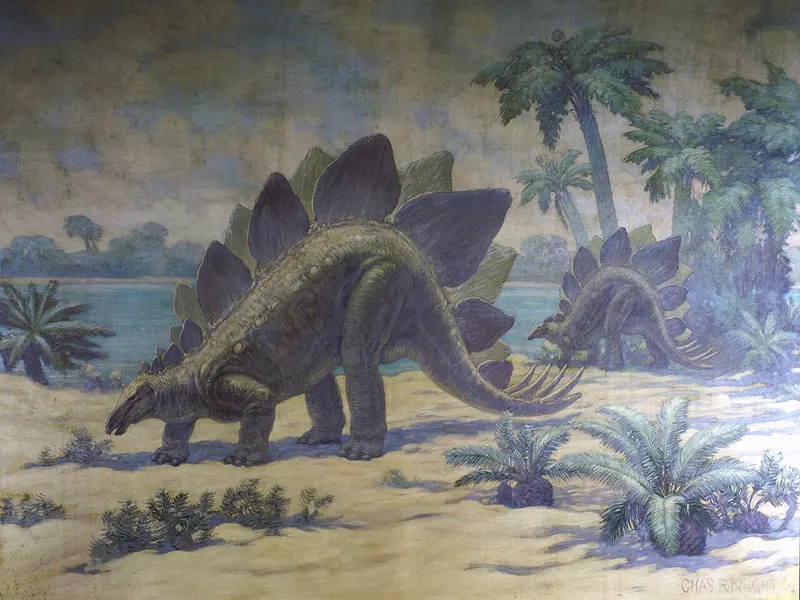
The Natural History Museum says Stegosaurus didn’t live in herds: probably alone or in small groups. Natural History Museum: Stegosaurus Q&A with Prof Paul Barrett Stegosaurus wasn’t common: on a Jurassic safari it would have been an interesting spot. Natural History Museum: Stegosaurus Q&A with Prof Paul Barrett
An AMNH curator says stegosaur fossils are often single animals, sometimes found with big sauropods, and stegosaur-only herds may have been rare. American Museum of Natural History: Apex Stegosaurus fossil and “11 Questions About Stegosaurus”
A 2015 study described a Montana quarry where at least five plated stegosaurs were buried together, which possibly suggests they were social. Saitta (2015), Evidence for sexual dimorphism in the plated dinosaur Stegosaurus mjosi, PLOS ONE
Fighting Allosaurus
Researchers have found Stegosaurus fossils with Allosaurus bite marks. Natural History Museum: Allosaurus (Dino Directory) The Natural History Museum lists Stegosaurus as food for Allosaurus. Natural History Museum: Allosaurus (Dino Directory)
A neck plate from the same quarry has a U-shaped notch that matches the front of an Allosaurus’s jaws. Smithsonian Magazine: Watch out for that thagomizer!, 2011 An Allosaurus tail bone from Utah’s Cleveland-Lloyd Quarry has a hole about 1.5 inches square that a Stegosaurus spike fits. The bone had started to heal. Smithsonian Magazine: Watch out for that thagomizer!, 2011
Of 51 Stegosaurus spikes studied, about one in ten had broken tips that had healed, a sign they were used in fights. Smithsonian Magazine: Watch out for that thagomizer!, 2011 Models suggest a spike driven in at an angle could get stuck and break, injuring both animals. Smithsonian Magazine: Watch out for that thagomizer!, 2011
In the Smithsonian’s Deep Time hall, a Stegosaurus swings its spiky tail at a Ceratosaurus. Smithsonian fact sheet: David H. Koch Hall of Fossils – Deep Time
Growing up
No Stegosaurus eggs have ever been found. The smallest juveniles known are about a metre long. American Museum of Natural History: Apex Stegosaurus fossil and “11 Questions About Stegosaurus” Nobody knows how long a Stegosaurus lived. American Museum of Natural History: Apex Stegosaurus fossil and “11 Questions About Stegosaurus”
Sophie was a young adult, still growing, when it died. Natural History Museum press release: World’s most complete Stegosaurus goes on show, 2014 Apex lived into old age, and the museum is studying a thigh-bone sample to learn how stegosaurs grew. American Museum of Natural History: Apex Stegosaurus fossil and “11 Questions About Stegosaurus” · checked 27 Oct 2026
Lengths, weights and dates for Stegosaurus are estimates from fossils, and the museums don’t all agree. The Natural History Museum gives 9 m and 152 to 145 million years ago, Sophie weighed about 1,600 kg but wasn’t fully grown, and an American Museum of Natural History curator describes an adult as about five tons. Where we give a figure, the source link says who said it and the date we checked it. See open questions for the disagreements side by side.