A turtle, wrist spikes and a second brain
Stegosaurus has been reimagined more times than almost any dinosaur. Here are the old ideas, and what replaced them.
A giant turtle
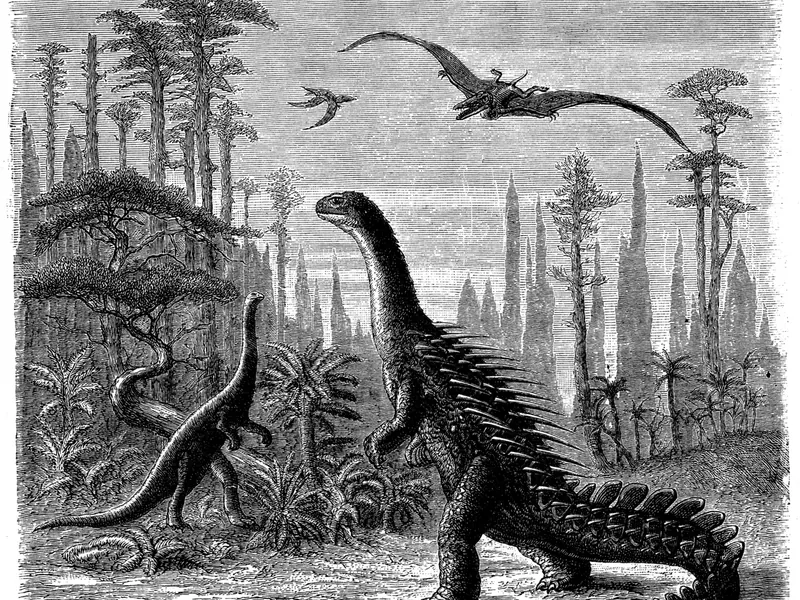
Stegosaurus was named by Othniel Charles Marsh in 1877. Natural History Museum: Stegosaurus (Dino Directory) When Marsh described Stegosaurus in 1877 he thought it looked like a giant turtle, with the plates forming a bony “roof”, hence the name. Smithsonian Magazine: The myth of the eight-spiked Stegosaurus, 2011
Marsh first thought the plates lay flat. A mud-covered specimen later showed they stood upright. Natural History Museum: Stegosaurus (Dino Directory)
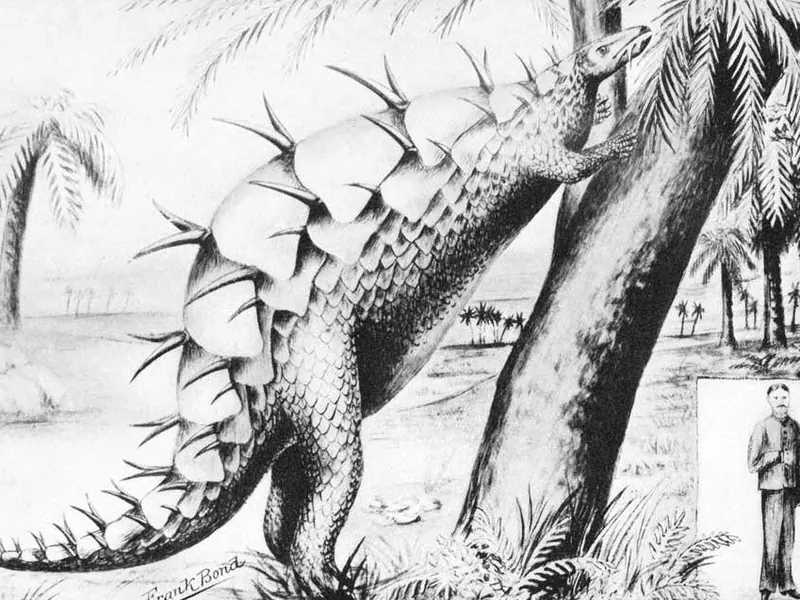
Wrist spikes and eight spikes
In 1880 Marsh suggested the spikes were on its wrists. Smithsonian Magazine: The myth of the eight-spiked Stegosaurus, 2011 A quarry sketch from collector William Reed showed spikes at the tail tip. Marsh changed his mind by 1887. Smithsonian Magazine: The myth of the eight-spiked Stegosaurus, 2011
Marsh’s 1891 skeleton drawing had eight tail spikes, a mash-up of several specimens. There is no evidence for any number other than four. Smithsonian Magazine: The myth of the eight-spiked Stegosaurus, 2011
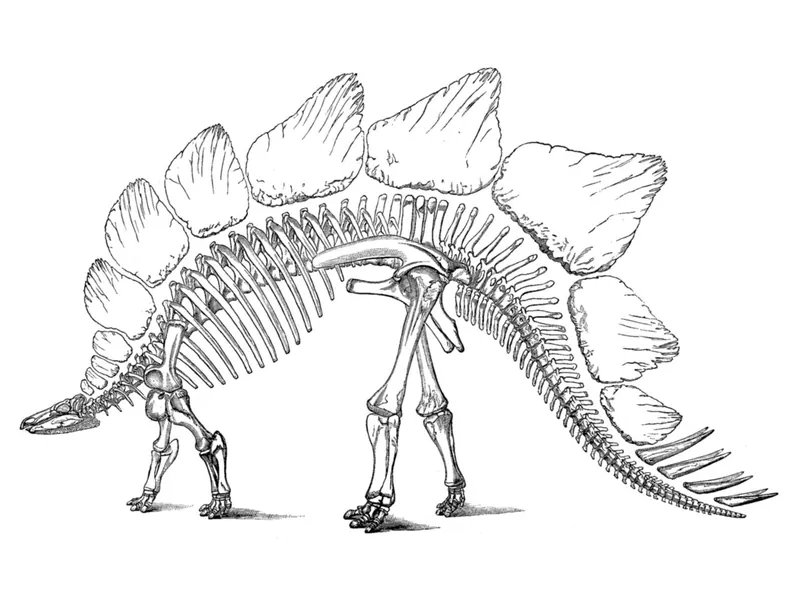
A second brain?
Marsh described a space in its hips as “a posterior braincase” in 1881, the start of the second-brain myth. Smithsonian Magazine: The double dinosaur brain myth, 2012 No dinosaur had a second brain. Smithsonian Magazine: The double dinosaur brain myth, 2012
The leading idea is that the hip space held a glycogen body, like birds have, though what it does is still unclear. Smithsonian Magazine: The double dinosaur brain myth, 2012 The Natural History Museum says the hip space was a store of food substances to help survive lean times. Natural History Museum: A Stegosaurus brought to life
An AMNH curator calls it an enlarged space for the nerve cord, not a brain. American Museum of Natural History: Apex Stegosaurus fossil and “11 Questions About Stegosaurus”
Early reconstructions
The name game
Marsh’s first species, Stegosaurus armatus (1877), was based on scrappy fossils. Smithsonian Magazine: Playing the stegosaur name game, 2010 In 2013 the official naming commission made Stegosaurus stenops the type species, replacing S. armatus. Maidment, Brassey & Barrett (2015), The postcranial skeleton of an exceptionally complete individual of Stegosaurus stenops, PLOS ONE
The Natural History Museum’s directory still lists the type species as armatus. Natural History Museum: Stegosaurus (Dino Directory) · checked 27 Oct 2026
Some scientists count Hesperosaurus as a species of Stegosaurus (Stegosaurus mjosi). Others, including one of the scientists who named it, say it is a separate genus. Smithsonian Magazine: Playing the stegosaur name game, 2010
Whether two fossils are separate species is decided by scientists comparing bones, and they don’t always agree. Smithsonian Magazine: Playing the stegosaur name game, 2010
The first stegosaur ever found?
The Natural History Museum calls Dacentrurus the first stegosaur ever discovered. Natural History Museum: Dacentrurus (Dino Directory) The Smithsonian says the first trace of a stegosaur was found in South Africa in 1845 and is now called Paranthodon. Smithsonian Magazine: Tracking cryptic stegosaurs, 2010
Dacentrurus was first named Omosaurus armatus, and its plates were once mistaken for the head plates of a giant fish. Smithsonian Magazine: Tracking cryptic stegosaurs, 2010
The two museums are answering slightly different questions: the first scrap of a stegosaur, or the first stegosaur recognised from a skeleton. We haven’t found a source that settles which counts as “first”.
State fossil
Stegosaurus became Colorado’s state fossil on 28 April 1982, after a fourth-grade class campaigned for two years. Colorado State Archives: Symbols & Emblems
Next: open questions →